
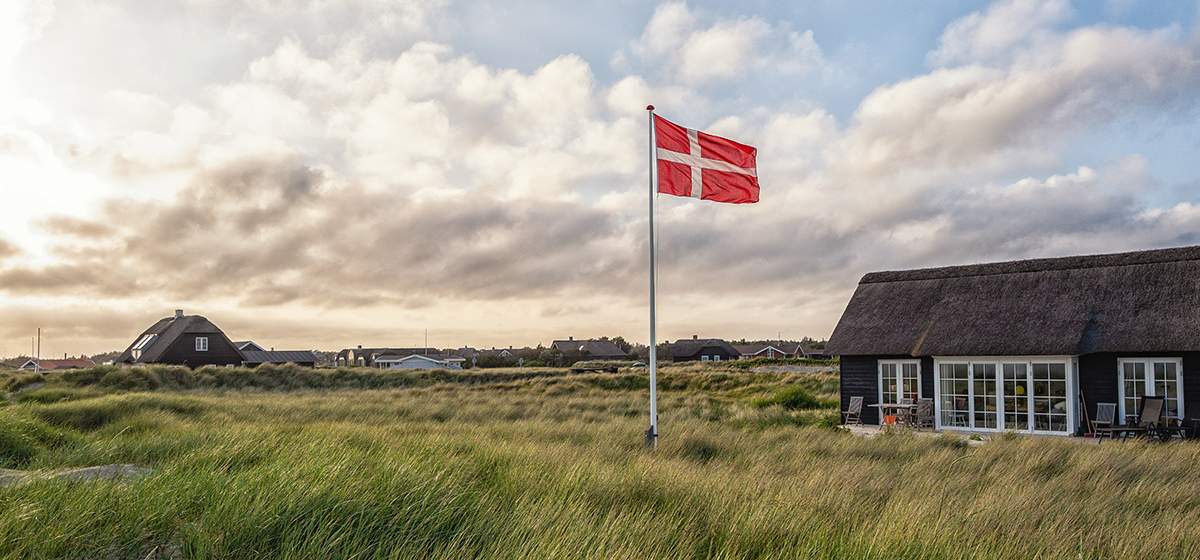
Danish is a Germanic language spoken by around 5 million people, mainly in Denmark, the Faroe Islands and Greenland. It is closely related to Norwegian and Swedish, so Danes, Norwegians and Swedes can understand one another.
The Danish language has a long and rich history. The oldest writings date from the 13th century. Although Danish has changed considerably over the centuries, it still has much in common with Old Norse, the language of the Vikings.
The Vikings were a North Germanic people who lived in Scandinavia from the 8th to the 11th century. They were famous seafarers and conquerors and founded settlements all over Europe, including England, Ireland, Iceland and Greenland. This Viking language, Old Norse, was a Germanic language very similar to today's Danish, Norwegian and Swedish. However, it also had some unique features, such as the use of an old form of writing, runes.
Over the centuries, Old Norse developed into the modern Scandinavian languages. Danish changed particularly strongly in the process, as it was heavily influenced by German.
Today Danish is spoken by a good five million people. It is the official language of Denmark and the Faroe Islands. It is also a lingua franca in Greenland and a minority language in South Schleswig (Schleswig-Holstein).
Danish is a relatively easy language to learn. The grammar is not very complex and pronunciation is fairly regular. There are also many similarities between German and Danish, which makes it easier for native German speakers to learn Danish.
Here are a few basic things you should know about the Danish language:
- Danish is written in the Latin alphabet.
- The Danish language has 29 letters, including two that do not exist in German: æ and ø.
- Danish pronunciation is relatively simple. There are only a few sounds that might be difficult for native German speakers.
- Danish grammar is not very complex. There are only three cases (nominative, genitive and dative) and four tenses (present, past, perfect and pluperfect).
Facts about the Danish language:
- Spoken in: Denmark, Faroe Islands, Greenland, South Schleswig (Schleswig-Holstein)
- Official language in: Denmark, Faroe Islands
- Speakers: approx. 5.3 million (native speakers)
- Language codes: da (ISO 639-1), dan (ISO 639-2/B), dan (ISO 639-3)
- Linguistic classification: Indo-European languages - Germanic languages -Scandinavian languages (North Germanic) - Danish
Danish - French
Photo: dirk - Adobe Stock
Listen to more than 1,700 professional voices or let us put together a casting for you.
Comments (0)