
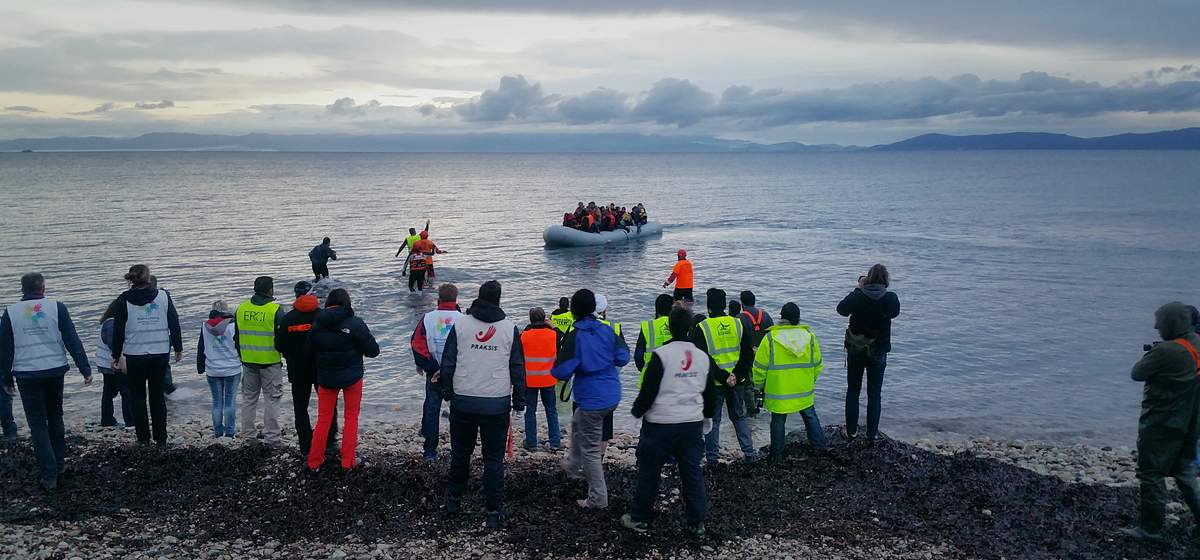
Together with cameraman Stefan Lehmann, our team is currently on Lesbos producing a short documentary about the refugee crisis. It focuses on the help – now perfectly organised – provided by many volunteers and NGOs on the ground.
Since the start of the refugee crisis, many hundreds of refugees have lost their lives off Lesbos. An exact figure is hard to determine, since not all of those who drowned are found. Yesterday alone, 18 refugees died trying to cross the roughly 12-kilometre stretch between the Turkish coast and the island of Lesbos by boat.
What makes the crossing to Lesbos so dangerous is above all the extremely poor quality of the boats. They are not, as you might assume, old boats fit for the scrapheap. The boats onto which the smugglers force the refugees – sometimes violently, if they have second thoughts in the face of the danger – are for the most part produced specifically for this purpose. But this is done so unscrupulously that the material often doesn't survive the 12-kilometre crossing. The boats can't be steered properly and are completely overloaded. There have also been cases where the life jackets handed out to the refugees by the smugglers didn't work. Instead of buoyancy aids, these jackets are filled with scraps of fabric that soak up water. In an accident, these jackets fill up with water and become a deadly trap. Even so, these jackets are often sold to the refugees for a surcharge of up to 100 euros each. Children are also given life jackets which, filled with air, are at most adequate as swimming aids in knee-deep water. Children often make up 30 to 40% of the people on the boats.
During our research, our team was consistently told that the smugglers charge between 1,000 and 1,500 euros for a crossing from Turkey to Greece. The smugglers' brazenness goes extremely far. Before the crossing, they even advertise the help of the volunteers and NGOs on the Greek side as included in the price.
In our short documentary, made in collaboration with the Cinema for Peace Foundation, we will present the situation and the work of volunteers and NGOs such as Sea-Watch. Our film is intended to be shown as an introductory short at screenings of documentaries and feature films dealing with the refugee crisis.
Inspired by the many volunteers on the ground who, regardless of nationality and religion, are working together to make the refugees' situation as bearable and safe as possible, we will try to raise the funding for a feature-length documentary.


Looking for a voice for your project?
Listen to more than 1,700 professional voices or let us put together a casting for you.
Comments (0)