
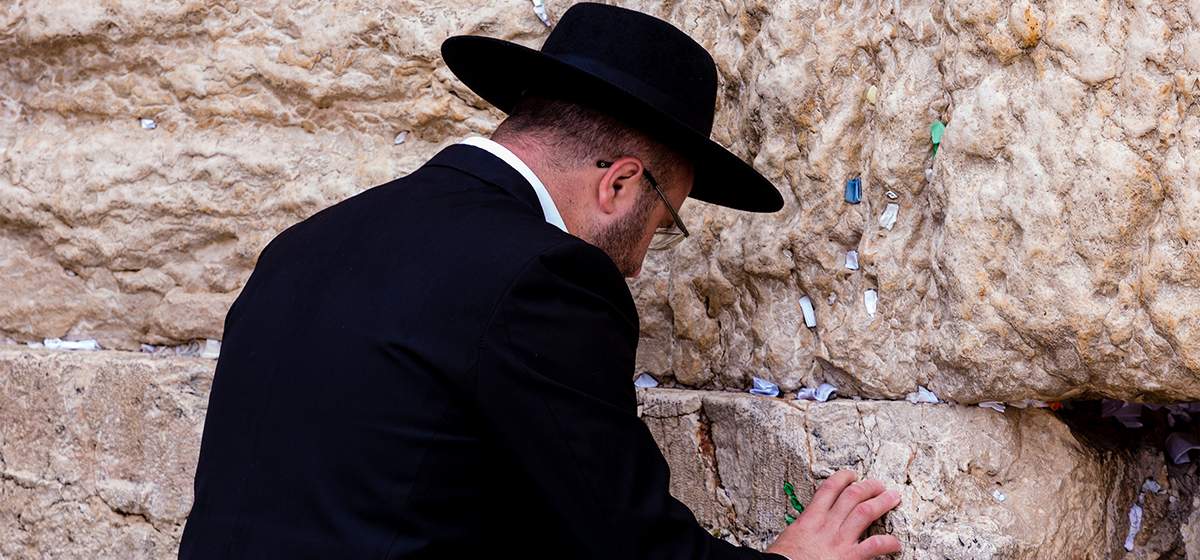
“If Moses came back today and asked for a piece of bread, he would be understood.” – This is how the first Prime Minister of the State of Israel, David Ben-Gurion, described the young national language Ivrit. Although Hebrew, which originated in the 1st millennium BC, is a very old language, by the end of the 19th century it played a role almost exclusively in Jewish liturgy and, due to its limited vocabulary, was unsuitable as an everyday language.
Shaped by the national movements in 19th-century Europe, the Zionist movement emerged, whose dream was a state of their own for Jews living all over the world. A common language therefore seemed an important basis for creating this shared national identity.
While studying in Paris, the Jewish journalist Eliezer Ben-Yehuda became a strong advocate of building up and settling Palestine. In 1881, at the age of 23, Ben-Yehuda set off with his wife for the Promised Land. After landing in Jaffa, they moved to Jerusalem. From the very beginning, Eliezer Ben-Yehuda was firmly resolved to raise his children exclusively in Hebrew. His children thus became the first people in many centuries to speak Hebrew as their mother tongue.
In the years that followed, Eliezer Ben-Yehuda worked on the first modern Hebrew dictionary. As a result of this work, in 1922 he succeeded in persuading the then High Commissioner of the British Mandate for Palestine to recognise Hebrew, alongside Arabic and English, as an official language of Palestine. Certainly an important step towards founding a new state. Finally, in 1948, the time had come, and Hebrew became an official language of the young State of Israel, together with Arabic.
A major challenge in transforming a sacred language into an everyday language was creating colloquial expressions. These words were mainly borrowed from Russian and Arabic, but partly also from English, German, Yiddish and French.
The Hebrew alphabet consists of 22 letters and, like Arabic, is written from right to left. What's special about this script is that it's a consonantal script. Vowels have to be supplied by the reader. There are certain vowel marks – additional dots or dashes indicating the presence of a vowel – but these are mostly used only in children's books, dictionaries or religious texts.
Facts about the Hebrew language (Ivrit):
- Spoken in: Israel, Palestinian territories
- Official language in: Israel
- Speakers: approx. 9 million
- Language codes: he (ISO 639-1), heb (ISO 639-2), heb (Modern Hebrew), hbo (Biblical, Rabbinic Hebrew) (ISO 639-3)
- Afro-Asiatic languages - Semitic languages - West Semitic languages - Northwest Semitic languages - Canaanite languages - Hebrew language - Modern Hebrew (Ivrit)
Photo: Jörn Witt
Listen to more than 1,700 professional voices or let us put together a casting for you.
Comments (0)