
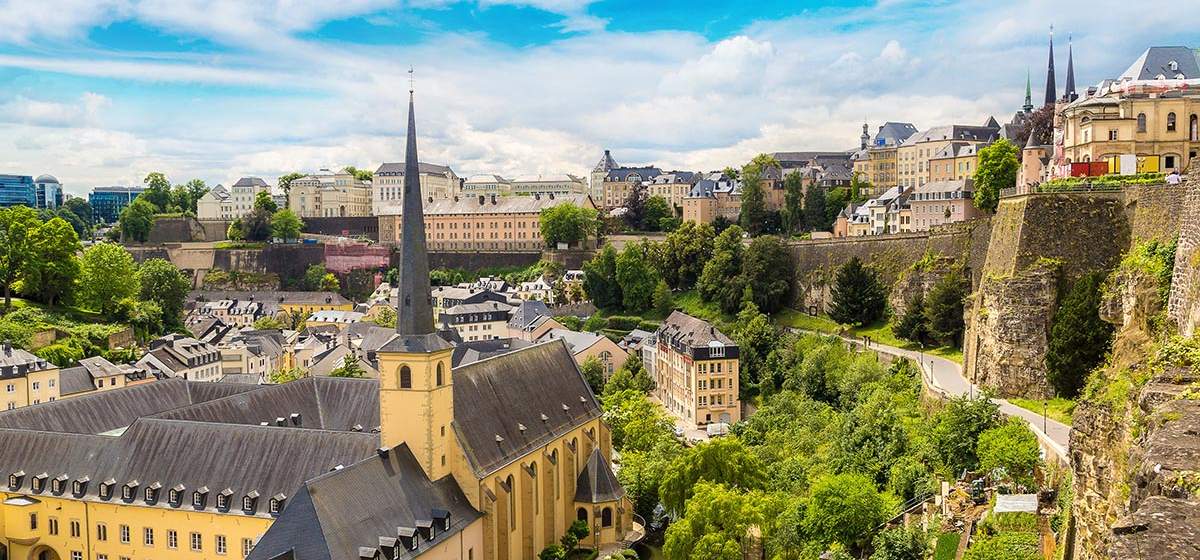
Lëtzebuergesch is the national language and, alongside German and French, one of the official languages of the Grand Duchy of Luxembourg. However, Luxembourgish has only been the official national language since 1984. Even so, the language is regarded as the mother tongue in Luxembourg and is therefore also the official colloquial language. Official documents, on the other hand, are mostly written in French. From the first year of school, lessons are taught in Luxembourgish and Standard German, with children learning to read and write in Standard German. French is also taught from either the first or the second year.
Linguists disagree, however, on the extent to which Luxembourgish can be called a standard language. On the one hand, it is a Central German variety; on the other, it exists in a sovereign state. An official spelling for Luxembourgish was introduced in 1946 – but without success – . In 1976, at the second attempt, an official school spelling was defined, which was itself reformed in 1999. Nevertheless, the language is passed on mainly orally and is used less as a written language. There is, however, a so-called dialect continuum with the Moselle Franconian dialects of Saarland and the region around Trier.
Luxembourg's first constitution in 1848 did not yet mention the Luxembourgish language. There was a free choice between German and French. Growing industrialisation and a certain prosperity from the steel industry led to an increasing national consciousness, which was further strengthened by the occupation of the country by German troops during the First World War. Lëtzebuergesch gained additional significance during Nazi rule. Luxembourg was to be incorporated into the German Reich, so German served as the sole official language. Luxembourgish was not banned, but using it was a sign of aversion to the German occupiers. This may also explain the stronger turn towards French after the Second World War.
Most radio and television media in Luxembourg broadcast in Luxembourgish, while most print media publish articles mainly in Standard German. French accounts for just under 20% there, and Luxembourgish for around 3%.
Because of its close proximity to Standard German, many words in the Luxembourgish vocabulary are related to German. Some words don't occur in Standard German but do in other German dialects. The Luxembourgish language is also strongly influenced by French. This dates back mainly to the time of Napoleon. Examples include “Fotell” (French “fauteuil”, armchair), “Vakanz” (French “vacances”, holiday) or “Forchette” (French “fourchette”, fork).
The Luxembourgish language uses the Latin alphabet, supplemented by the letters ä, ë and é, ö and ü. Within the EU, Luxembourgish is one of the minority languages, but not one of the official languages.
Facts about the Luxembourgish language:
- Spoken in: Luxembourg, south-west Eifel (Bitburg, Germany), Moselle valley (Trier, Germany), parts of Belgium, parts of Lorraine (France), western parts of Saarland (Germany)
- Official language in: Luxembourg
- Speakers: just under 400,000
- Language codes: lb (ISO 639-1), ltz (ISO 639-2), ltz (ISO 639-3)
- Linguistic classification: Indo-European – Germanic – West Germanic – High German – Central German – West Central German – Central Franconian – Moselle Franconian – Luxembourgish
Photo: Sergii Figurnyi – Adobe Stock

Listen to more than 1,700 professional voices or let us put together a casting for you.
Comments (0)