
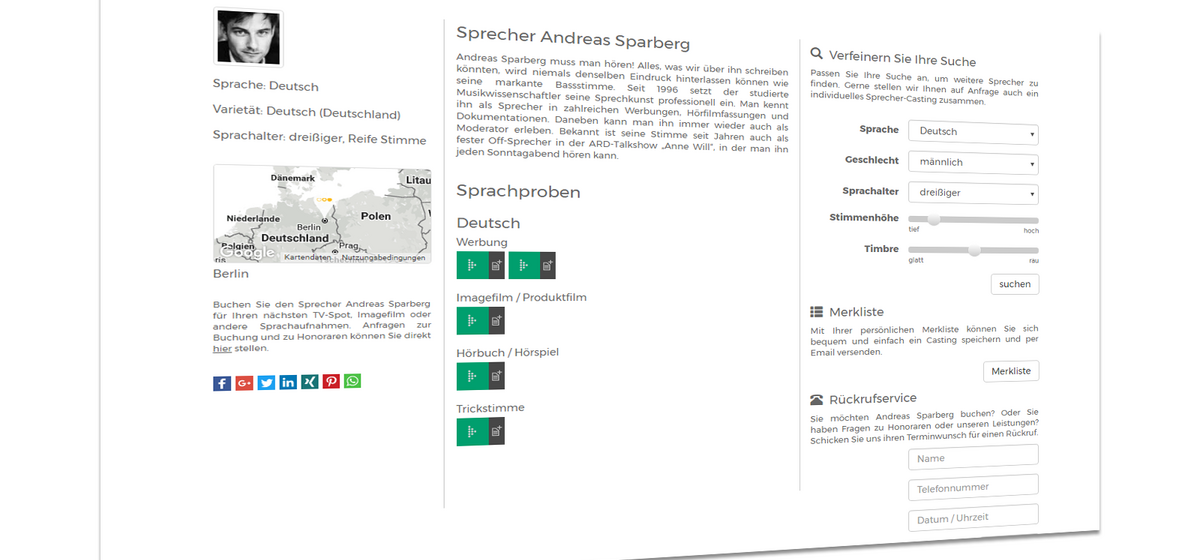
Our blog series "Finding the right voice artist" is, of course, all about exactly that question. How can you find the voice artist who is a 100% fit for your project? Your first thought may be that you'll hear straight away whether a voice suits your project, whether it's good or whether you'd be better off with an alternative. But to be able to judge that, you first need a meaningful casting. Of course, you could go through all the voice artists on our site from A to Z and try to discover the perfect voice. But when you consider that our database holds more than 1,000 voice artists and a good 7,000 voice samples in total, it could take you more than one night shift to reach a result.
Today, in the first part of our series, we'd like to look at our new advanced search function and briefly explain what our voice search has to do with personality psychology and how you can playfully listen your way through our voice samples.
Our search is basically divided into two different search strategies:
1. There are search criteria (language, gender, voice age, pitch and timbre) that relate to a voice artist.
2. There are search settings (sample category, temperament, seriousness and cheekiness) that let you pick out matching samples from the voice artists.
Combining the two means that your search results show you not only the right voice artists but also the right demos. For you, this means the search becomes more specific and faster, and you can filter the range of each individual voice artist more directly.
The lexical approach
The big question that occupied us as an agency was: how can you describe a voice or a voice sample beyond the general parameters already mentioned? After some research, we turned to personality psychology for help. One of the most important models there is the so-called "Big Five". These "Big Five", which describe a person's personality structure in five main dimensions, are based on the lexical hypothesis of Gordon Allport and Henry Sebastian Odbert (1936). Allport and Odbert assumed that a person's personality traits must be reflected in the words of everyday language. This approach produced a list of more than 18,000 terms. Using factor analysis, five factors were found that describe a person's personality and, interestingly, have even proved to be extremely stable across cultures: the "Big Five"!
We took our cue from this method and collected our own list of adjectives for describing a voice or a voice sample. Admittedly, it wasn't quite as extensive, but we were able to isolate several hundred adjectives that in some way represent a vocal expression. Similar to the “Big Five”, we were able to derive five factors from them that proved extremely meaningful for describing a voice recording: pitch, timbre, temperament, seriousness and cheekiness. Armed with these factors, we developed a team rating system to test how much variance there is in rating voice samples on these factors. On a scale from 0 to 10, each of us independently rated a set of samples. We found that there was extremely high agreement in the ratings, with very little variance. Our model worked! So we started rating the roughly 6,000 voice samples that were in our database at the time. This allowed us to map these factors in a search function, where you can intuitively set these parameters using sliders.
Our search function
We'd like to briefly explain the individual elements of our search form, even though at first glance they seem intuitive and simple. But with a bit of detailed information you'll be able to use them even better.
Language
This one is almost self-explanatory: it's about the language a voice artist speaks. What's special about our search, however, is that for languages that have a so-called variety, there's a second option to choose it. One variety of German, for example, would be Austrian German, which differs considerably from the German variety of German in its pronunciation of standard German and in individual words. It's similar with other languages such as English, Spanish, Portuguese or Chinese.
Gender
Even though the division into "male" and "female" doesn't represent every possible gender expression, it's generally sufficient for a voice search. And that's this point explained!
Voice age
As the name suggests, voice age is a rough estimate of which age group a voice can be placed in when you hear it. Since this obviously can't be heard to the exact year, dividing it into groups such as “teenager”, “young adult”, “thirties” and “mature voice” has proved very useful.
Category
Here comes the first parameter that triggers a search for specific voice samples rather than for voice artists in general: the "sample category". We've divided the voice samples into specific production categories such as "advertising", "audiobook", "product film" etc. A sample from the right category gives you a much better and more accurate impression of how the voice artist sounds in your production's field.
Pitch and timbre
These are the first two parameters from our factor model. On a scale from 0 to 10, you can use sliders to set the pitch and timbre (the "roughness") of the voice and filter the search results accordingly.
Temperament
On a scale from 0 to 10, temperament describes whether the demo sample or the expression of the voice is more "calm" or "hyper". Of course, this is often a crucial question, as a commercial for a bank will certainly call for a different temperament than the voice recording for a trendy flea-market app for girls.
Seriousness
"Serious" and "rebellious" are the two opposites here. Again, you can use a slider on a scale from 0 to 10 to set the expression of the voice sample you're looking for.
Cheekiness
On this scale you can set the intensity between "well-behaved" and "cheeky". Now you might ask: what's the difference from "serious" and "rebellious"? When analysing the adjectives, we quickly noticed that the two expressions mean something quite different. For example, even a serious voice can give something a "cheeky" accent.
Even if this explanation of our search function may seem a little too detailed: in the end it is above all one thing – intuitive. It's meant to help you put together a suitable casting for your project.
And speaking of casting: in the next episode of "How do I find the right voice artist?" we'll look at our shortlist – how to put together a casting on our website from the voice samples you've found and conveniently send it to yourself or your clients by email.

Listen to more than 1,700 professional voices or let us put together a casting for you.
Comments (0)