
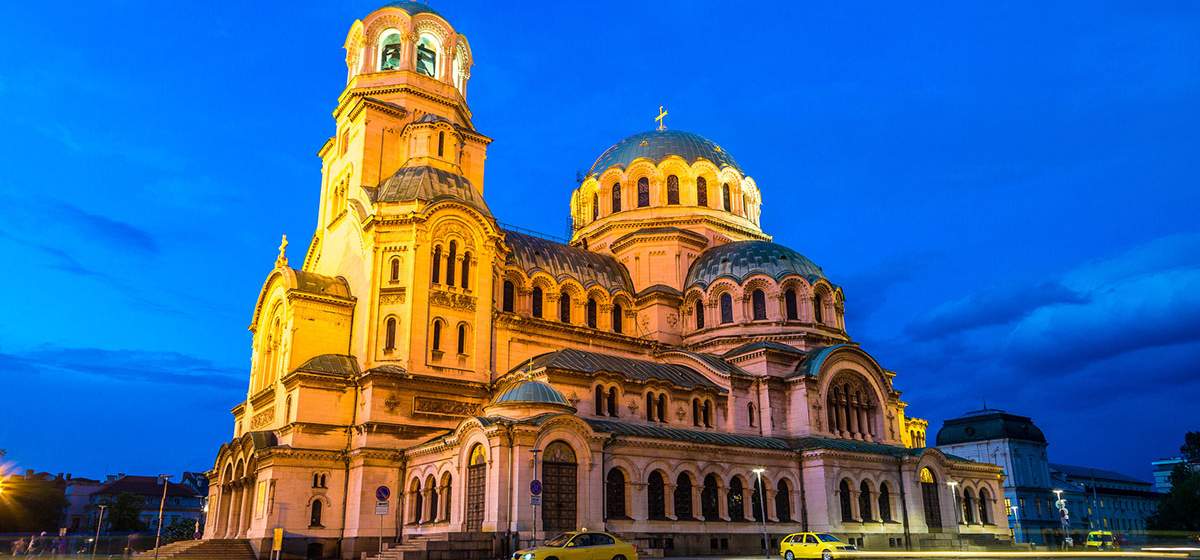
Bulgarian is one of the earliest documented Slavic languages. Together with Macedonian, it forms the subgroup of the Eastern South Slavic languages. Just under eight million people speak Bulgarian, most of them in Bulgaria itself (approx. 7.7 million people).
The development of the Bulgarian language can be summed up in three periods.
The Old Bulgarian period begins in the 9th century and describes the time when the Slavic language was adopted as the official language of the First Bulgarian Empire. The Old Bulgarian period ends around 1018 with the fall of the empire. The Cyrillic alphabet also emerged during this period.
The Middle Bulgarian period lasted from the 12th to the 14th century. It covers the time from the restoration of the Bulgarian Empire to its subjugation by the Ottoman Empire. The Tarnovo school also falls within this period. In the spirit of early humanism, linguistic, orthographic and stylistic reforms took place that also strongly influenced linguistic development in the territories of today's Romania, Moldova, Serbia, Ukraine and Russia. In the Slavic Orthodox Church, this language is still the official liturgical language today.
The Modern Bulgarian period refers to the time since the 15th century. During a “Bulgarian National Revival”, the need for literature to be written in the vernacular was recognised above all. The Eastern Bulgarians played a special role in the development of this standard language. Due to the dominance of publications in Eastern Bulgarian dialects, these had an extremely strong influence on Modern Bulgarian. These dialects were also very close to Russian, which strengthened the influence of Russian culture on Bulgaria. The first Bulgarian schoolbook, published by Petar Beron in Kronstadt in 1824, was also written in the typical Eastern Bulgarian dialects of that city.
Today, three main dialect groups are distinguished in Bulgarian: Western Bulgarian dialects, Eastern Bulgarian dialects and Rup dialects. Western Bulgarian dialects comprise the north-western Bulgarian dialects, the south-western dialects and various transitional dialects. Eastern Bulgarian dialects refers to the Balkan dialects and the Moesian dialects. Rup dialects are the Rhodope dialects, the Eastern Rup dialects (south of the Thracian Plain to the Turkish border and in the Strandzha mountains) and the Western Rup dialects.
The vocabulary of the Bulgarian language consists mainly of inherited Slavic words. There are also many Greek and Turkish loanwords. Bulgarian is written in a special variant of the Cyrillic alphabet with 30 letters (А, Б, В, Г, Д, Е, Ж, З, И, Й, К, Л, М, Н, О, П, Р, С, Т, У, Ф, Х, Ц, Ч, Ш, Щ, Ъ, Ь, Ю, Я). But words have also been borrowed from German, for example: Auspuff/exhaust (ауспух), Backenbart/sideburns (бакенбард), Backpulver/baking powder (бакпулвер), Edelweiß/edelweiss (еделвайс), Leberwurst/liver sausage (лебервурст), Schiebedach/sunroof (шибидах), Wunderkind/child prodigy (вундеркинд), Zeitnot/time pressure (цайтнот) or Zugzwang (цугцванг).
Facts about the Bulgarian language:
- Spoken in: Bulgaria, Ukraine, Moldova, Hungary, Macedonia, Greece, Serbia, Romania, Turkey
- Official language in: Greece, Athos, European Union
- Speakers: approx. 7.8 million
- Language codes: bg (ISO 639-1), bul (ISO 639-2), bul (ISO 639-3)
- Linguistic classification: Indo-European languages - Slavic languages - South Slavic languages - Eastern South Slavic - Bulgarian
Photo: Sergii Figurnyi - fotolia.com

Listen to more than 1,700 professional voices or let us put together a casting for you.
Comments (0)