
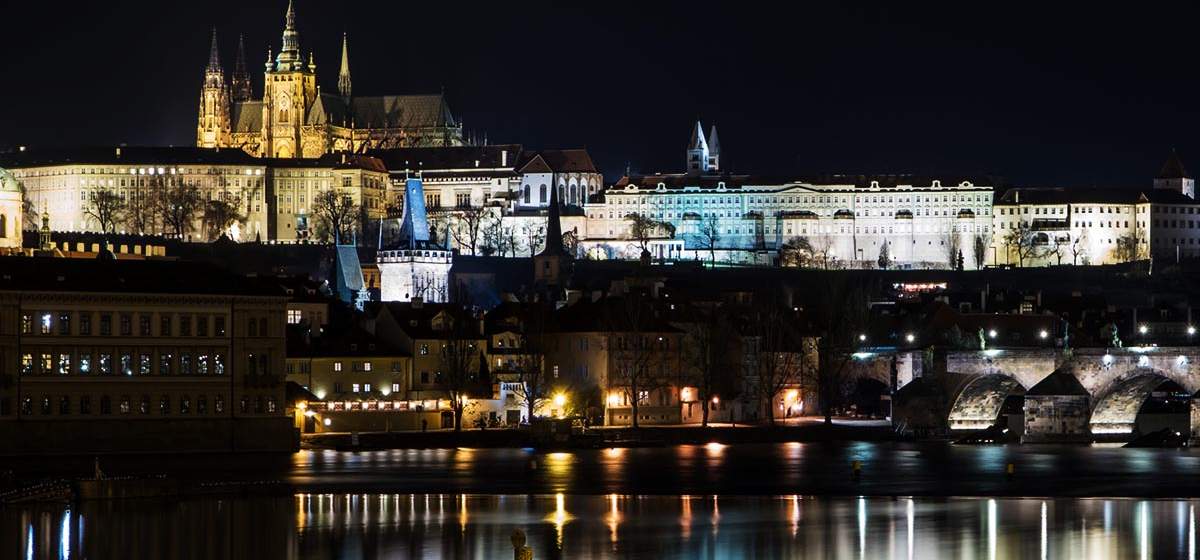
Czech is a Slavic language. More precisely, it belongs to the West Slavic languages within the Indo-European language family. The Czech language and Czech literature are studied academically within the field of Bohemian studies.
The first evidence of an Old Czech language (Bohemian) dates back to the 12th century. These sources are mainly religious texts and songs. From the 14th century there is also courtly poetry. In the 15th and 16th centuries, Czech was used as the language of documents in Upper Silesia, pushing back German in that region.
After the troops of the Bohemian estates were defeated by the imperial and Bavarian troops of the Catholic League at the "Battle of White Mountain" in 1620, during the Thirty Years' War, the Counter-Reformation and the influence of the Habsburgs gradually pushed back the Czech language, so that German dominated once again.
In 1880, in the course of the “National Revival”, in which intellectuals formed the Czech national movement, Czech once again became an official language in Bohemia and Moravia. However, Czech never achieved full equality with German during this period. This only changed with the end of the First World War and the resulting end of the Habsburg Danube monarchy.
Although Czech and Slovak differ in pronunciation – especially in stress and sound system – Czechs and Slovaks can usually understand each other without difficulty thanks to the similarities between the two languages and the shared history of Czechoslovakia. For example, it is even enshrined in law that either language may be used in dealings with the authorities.
Due to historical developments, Czech has a relatively large number of words borrowed from German. Examples include knedlík for Knödel (dumpling), valčík for Walzer (waltz), knoflík for Knopf (button) or brýle from Brille (glasses). Conversely, there are also some words in German that come from Czech, such as Zwetschge (plum) from švestka or Zeisig (siskin) from čížek.
The colloquial language (Common Czech, Common Bohemian, obecná čeština) differs significantly from written Czech (spisovná čeština). This colloquial language is widespread mainly in Bohemia. Linguists call it an “interdialect”, because its geographical spread overlays other local dialects. The forms of Czech spoken in Moravia, on the other hand, are grouped together from various dialects as the “Moravian language”. The “Brno colloquial language” is a form of Rotwelsch, a sociolect of the late Middle Ages.
In total, five dialect groups are distinguished in the Czech Republic: the Bohemian, Moravian, East Moravian and Silesian groups, plus the border areas, which have no uniform dialect affiliation.
A particularly old colloquial form of Czech has survived in the Banat. Especially in the territories of present-day Romania and Serbia there is a Czech minority that has preserved this dialect.
Facts about the Czech language:
- Spoken in: Czech Republic, Slovakia, Austria
- Official language in: Czech Republic, European Union
- Speakers: approx. 13 million
- Language codes: cs (ISO 639-1), cze (ISO 639-2,B), ces (ISO 639-2,T), ces (ISO 639-3)
- Linguistic classification: Indo-European languages - Slavic languages - West Slavic languages
Photo: animaflora - fotolia.com
Listen to more than 1,700 professional voices or let us put together a casting for you.
Comments (0)