
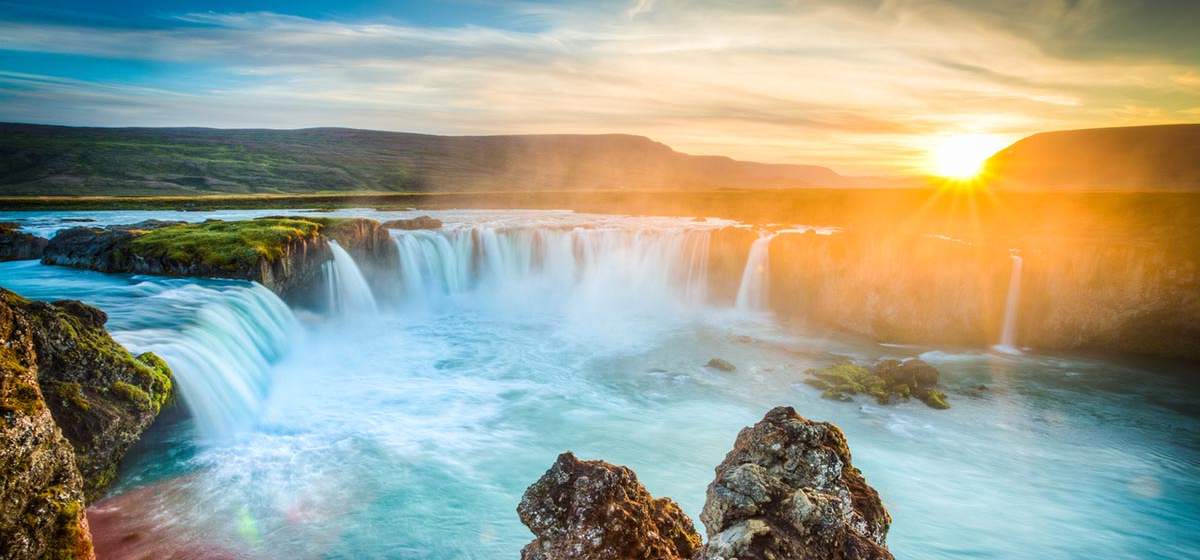
Íslenska is the language spoken on the world's largest volcanic island near the Arctic Circle: Iceland. Today's Icelandic goes back to Old Icelandic from the High and Late Middle Ages, which in turn was very similar to Old Norwegian, as many settlers in Iceland came from the south-west coast of Norway. Even today, Icelandic still bears a strong resemblance to the south-western Norwegian dialects and to Faroese.
During the early modern period, Icelandic was heavily influenced by Danish and Low German, mainly due to the translations of the New Testament by Oddur Gottskálksson (1540) and the Corvinus Postilla (1546). The Icelandic language was further influenced not only by the Reformation, but also by merchants who traded mainly on Iceland's south coast.
From the end of the 18th century there were attempts to actively counter the influence of other languages on Icelandic. In 1779 the Icelandic Literary Society (Hið íslenzka Lærdómslistafélag) was founded. Various grammars and dictionaries were subsequently published. Around 1816 the Icelandic Bible Society published a new translation of the Bible, written with the aim of drawing on the original, unadulterated Icelandic language.
From 1844, all Danish officials in Iceland were obliged to speak Icelandic. Four years later, a professorship in Icelandic was established at the University of Copenhagen for the first time. In these years, spelling also returned to Old Icelandic. Finally, in 1918, the year Iceland gained independence from Denmark, an official dictionary of the Icelandic state was published.
The Icelandic language has very little dialect variation, limited almost entirely to the phonetic and phonological level. The oldest surviving document in Icelandic is the “Reykjaholtsmáldagi”, a cartulary containing copies of the deeds of the church of Reykholt. The oldest entries date from around 1185.
One peculiarity of Icelandic is that there are sentence constructions without a nominative (“quirky case”). Another peculiarity is the effort to avoid taking too many foreign words into the language. In 1964 a committee was founded with the task of finding purely Icelandic expressions for new terms. For example, a “computer” in Icelandic is “tölva”. The term is made up of the Icelandic words for “number” and “prophetess”. Electricity is called “rafmagn”, which means something like “amber power”, and an aeroplane is a “þota”, a fast bird.
Personal names are another peculiarity of Icelandic. In Iceland the first name is the most important part of a name, while family names are rather rare. Children often take their father's first name as their surname, with “dóttir” (“daughter”) or “son” added. The daughter of a man called Kristófer might, for example, be called Freyja Kristóferdóttir.
The Icelandic alphabet has 32 letters, which largely correspond to the Latin alphabet. In addition to the Latin letters there is “Ð/ð”, pronounced like the English “th” in “this”, “Þ/þ” from the runic alphabet, pronounced like the harder English “th” in “thing”, “Æ/æ” (pronounced “ai”) and, as in German, “Ö/ö”. All vowels (including “y”) can be written with or without an accent. (A / a, Á / á, B / b, D / d, Ð / ð, E / e, É / é, F / f, G / g, H / h, I / i, Í / í, J / j, K / k, L / l, M / m, N / n, O / o, Ó / ó, P / p, R / r, S / s, T / t, U / u, Ú / ú, V / v, X / x, Y / y, Ý / ý, Þ / þ, Æ / æ, Ö / ö)
Facts about the Icelandic language:
- Spoken in: Iceland
- Official language in: Iceland, Nordic Council
- Speakers: approx. 310,000
- Language codes: is (ISO 639-1), ice (ISO 639-2,B), isl (ISO 639-2,T), isl (ISO 639-3)
- Linguistic classification: Indo-European languages - Germanic - North Germanic
Photo: ronnybas - fotolia.com
Listen to more than 1,700 professional voices or let us put together a casting for you.
Comments (0)