
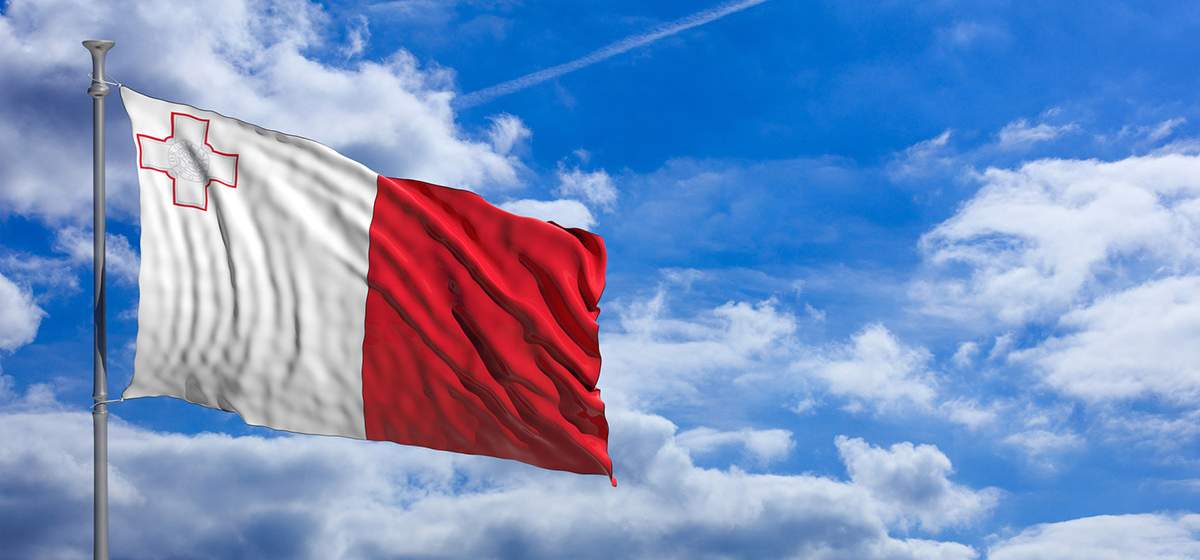
Maltese (Malti) is one of the Semitic languages (like Arabic or Hebrew, for example) and belongs to the Afro-Asiatic language family. It originally developed from an Arabic dialect and is thus the only independent Semitic language in Europe – and the only one to use the Latin alphabet.
After Malta was conquered by the Arabs around 870, a vernacular of its own developed there. At first it was a dialect of Maghrebi Arabic, but through Christianisation it developed independently of the Arab cultural sphere, and through its ties to Catholic Europe it evolved in its own way. Italian and English in particular had a great influence on its development.
After 1091 Malta first came under Norman rule, but it wasn't until 1240 that the Muslims were expelled by the Hohenstaufen king Frederick II, who was not only Emperor of the Holy Roman Empire but also King of Sicily. With the arrival of Sicilian feudal lords, Italian gained in importance and influenced the Maltese language.
Later, Malta, together with Aragon and Castile, belonged to the Spanish kingdom ruled by the Habsburgs. Emperor Charles V finally handed the island over to the Order of St John (the Order of Malta) in 1530. As a result, French gained a certain importance as the language of communication between the knights of the order and the population.
In 1789 Napoleon's revolutionary troops conquered the island. Maltese insurgents asked Great Britain for help, which then blockaded the island's ports. The French troops left Malta in 1800, and in 1814 Malta became a British crown colony. From then on, English had a major influence on Maltese. To this day, English is an official language on the island alongside Maltese. However, even during this period Italian retained its importance as the language of education and the courts, and only lost its status as an official language in 1934.
Malta finally became independent in 1964, but the monarchy was only abolished in 1974. Until then, the British Queen was still Malta's head of state. Since its independence from Great Britain, Malta has been a member of the Commonwealth of Nations.
As already mentioned, Maltese is the only Semitic language written in the Latin alphabet. The special characters “Ċ”, “Ġ”, “Ħ”, “Ż” and “Għ” are also used. Pronunciation now differs greatly from Arabic, yet there are many related words, such as city (Maltese: belt, Arabic: بلد (balad)), sky (Maltese: sema, Arabic: سماء (samāʾ)) or month (Maltese: xahar, Arabic: شهر (šahr)). Despite the differences in phonology and syntax compared with Arabic that have arisen over the centuries, the basic structure can still clearly be assigned to the Semitic languages.
Facts about the Maltese language:
- Spoken in: Malta
- Official language in: Malta, European Union
- Speakers: approx. 400,000
- Language codes: mt (ISO 639-1), mlt (ISO 639-2), mlt (ISO 639-3)
- Linguistic classification: Afro-Asiatic languages - Semitic languages
Photo: Rawf8 - fotolia.com

Listen to more than 1,700 professional voices or let us put together a casting for you.
Comments (0)