
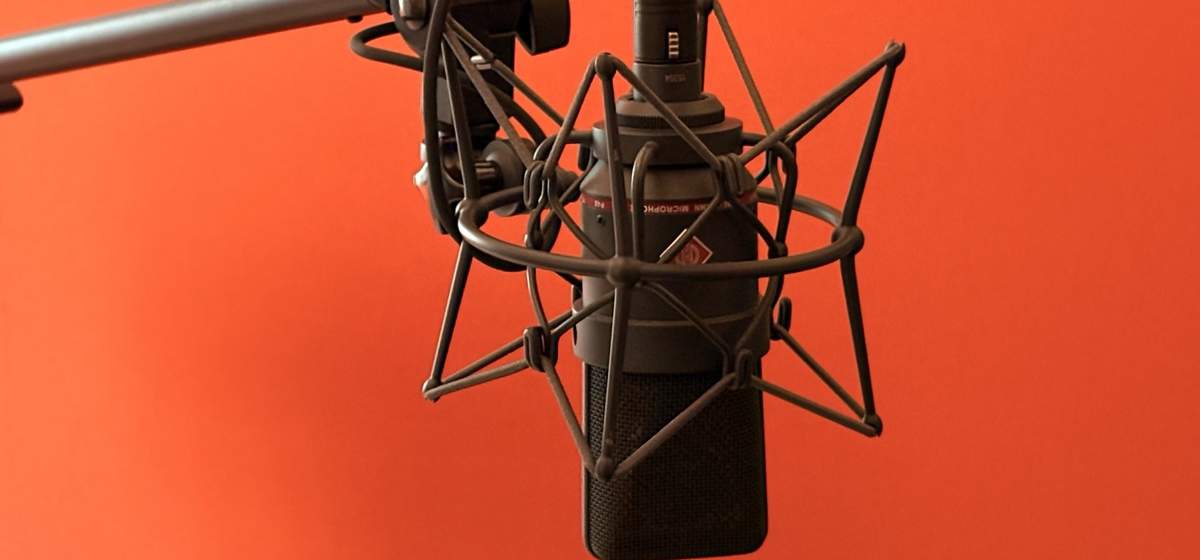
There's one question we get asked at least once a month: “Which microphone do you record with?”
The honest answer is: it depends. And that's not a dodge, it's the whole point.
The microphone is the smallest link
Before we talk about models, some context that tends to get lost in tech articles: of everything that makes up the sound of a voice recording, the microphone is not the most important factor.
First comes the voice. Then the room. Then the distance to the microphone and how someone keeps it while speaking. Only after that does the technology get a say.
A top-class microphone in an echoey room sounds worse than a decent microphone in a properly built booth. Get that the wrong way round and you're buying yourself disappointment. That's why most of our effort goes into the rooms and not onto the shelf.
What is true, though: once voice, room and distance are right, the chain decides the last ten per cent. And in our business, we live off those ten per cent.
TLM 170 and U 87: measurement versus opinion
Our standard microphone is the Neumann TLM 170 R. It is transformerless, uses the K 89 dual-diaphragm capsule and offers five polar patterns – from omni to figure-of-eight. What's interesting is less the choice than the property it enables: the frequency response stays linear in all five patterns, even off axis. The microphone reproduces what's there without adding its own opinion.
On top of that comes a quality that is worth more in everyday work than any promise of sound: predictability. Whether someone narrates quietly or speaks emphatically, the sound stays practically the same. With 14 dB-A self-noise and a maximum SPL of up to 154 dB with pre-attenuation, there are no surprises at either end.
The U 87 is the opposite of this philosophy – and that's why it stands next to it. It has an output transformer, three polar patterns and a capsule with an opinion: a gentle presence boost, flattering mids, a top end that rounds rather than sharpens.
To put it simply: the TLM 170 is a measurement, the U 87 an opinion.
Which one is better depends entirely on the voice. A young, slender voice gains body and authority on the U 87. A voice that is already present and tends towards sibilance tips into harshness on it – and that's exactly where the TLM 170 plays to its strengths, because it adds nothing you'd later have to painstakingly remove.
That's why choosing the microphone isn't a ritual for us, but the first test of the session.
Two amplifiers from German broadcasting
Behind the microphones sit two preamps, both recreations of historic circuits – built by 51X Audio in 500 format.
One follows the Neumann PMV70. In the early seventies this was Neumann's first in-house microphone preamp cassette, with discrete Class A amplifier stages and encapsulated input and output transformers. These modules sat in broadcast consoles and had to meet strict German broadcasting standards. Their reputation: warm, round, a touch darker than their more famous successor, the V 476.
The other follows the Telefunken V672, the amplifier module of the German public broadcasters, built with original NOS transformers. More open and faster than the Neumann, with the clarity broadcast technology was designed for.
Hear the two side by side and you suddenly understand why German documentaries and radio plays of a certain era sound the way they do. It wasn't the zeitgeist. It was these circuits – and they run in our studio every day.
Both are on our patch bay, together with the microphones. So there's no fixed chain, but a decision – by genre, by voice artist, by the desired sound. It takes a few minutes at the start of a session and saves hours in post-production.
The TLM 103: the microphone that's not supposed to win
The third microphone in the house is a Neumann TLM 103. It isn't in daily use – and the reason for that is perhaps the most interesting part of this article.
Technically, it's a close relative of the U 87: its capsule is based on the classic K67/87 design but was given a more modern voicing with a broadband presence boost above 5 kHz. As a result it sounds more direct and more “finished” than the original it's modelled on. At 7 dB-A it is also one of the quietest microphones there is.
But we don't have it because it's good. We have it because the world uses it.
The TLM 103 is one of the most widespread microphones in professional home booths. When we add to a production that was made elsewhere – pick-ups, an extra sentence, a correction two weeks later – the switch must not be audible. So we reach for the microphone that comes closest to the sound of the original recording.
That's the least spectacular and at the same time most professional job a microphone can have: not standing out.
Incidentally, our chain fills a gap the microphone leaves. The TLM 103 has no pad and no low-cut filter – our preamp brings a switchable high-pass filter at 80 and 140 Hz. A chain is planned, not bought piece by piece.
What this means for your production
We run three studios, and the relevant consequence isn't capacity but repeatability. A voice recording rarely ends with the session. There are corrections, variants, versions for other markets. These pick-ups have to blend in inaudibly with what was recorded before – same microphone, same position, same chain, documented.
That's why a production studio uses a predictable microphone, not the one with the most character. You can add character. You can't add predictability.
And if you have your own booth
For voice artists who record at home, we'd sum it up like this: the leap from a good to a very good microphone is smaller than the leap from a mediocre to a well-treated room. If you have money to spare, invest it first in acoustics, distance and recording discipline.
And if it really has to be a new microphone: don't buy the best one, buy the one that suits your voice. Surprisingly often, those are not the same.
That's exactly what we talk about in our workshops and during demo recordings – and we hear it every week in the recordings that reach us from home booths.
So: which microphone?
The one your voice sounds best on. We know which one that is after two minutes of speaking – and that's why every route on our patch bay is open.
Listen to more than 1,700 professional voices or let us put together a casting for you.
Comments (0)