
The Greek language belongs to the Indo-European language family, within which Greek forms a branch of its own. When we talk about the Greek language in general, we of course mean Modern Greek (Neoellinikí Kiní / Νεοελληνική κοινή), the language spoken today. Besides Ancient Greek, which took shape around 800 to 300 BC, there are other stages in the development of the Greek language. Proto-Greek can be dated to around 2000 BC; Mycenaean was spoken around 1600–1100 BC. The development towards Modern Greek went via Koine, which was spoken from the Hellenistic period to the Roman imperial era (around 300 BC to 600 AD), via Late Antique Greek and via Medieval Greek.
After the conquest of Constantinople by the Ottomans in 1453 and the collapse of the Byzantine Empire, Greek no longer had official status. It was still spoken here and there in the Greek territories occupied by the Ottomans. After the revolution and the founding of the Kingdom of Greece (1830), Greek became the sole official language. Until 1976, Modern Greek had two different forms: Dimotiki (Δημοτική) and Katharevousa (Καθαρεύουσα). Dimotiki is the traditional vernacular; Katharevousa is an artificial language modelled on Classical Greek. Educated nationalist circles wanted it to create continuity with the great past of Greek antiquity. However, Katharevousa was abolished as an official language after the end of the Greek military dictatorship. Many Katharevousa words nevertheless found their way into the spoken language, so that the Modern Greek spoken today is regarded as a kind of synthesis of these two forms.
Modern Greek is spoken very uniformly. Still, slight differences can be observed, allowing a division into two types of dialect: the northern and the southern dialects. The northern dialects are spoken on the Greek mainland north of Chalkida, on the Northern Sporades and on the islands of Thasos, Samothrace, Lemnos, Lesbos and Samos. The southern dialects are divided into Peloponnesian-Ionian, Old Athenian and Maniot, Cretan-Cycladic, and the south-eastern dialects.
In Greek, the stress falls on exactly one syllable and is marked in writing with an accent. As a result, some words differ only in their stress (for example nómos (νόμος, law) and nomós (νομός, district)). This can easily lead to confusion if you're a non-native speaker unfamiliar with the pronunciation.
Over the centuries, Modern Greek has adopted many words, especially from Italian, Turkish, French and English. For example, the Italian scala (staircase) became the Greek σκάλα (skála), the Turkish tüfek (rifle) became τουφέκι (touféki), the French crayon (lipstick) became κραγιόν (kragión) and the English sandwich became σάντουιτς (sándouits).
Despite Greece's turbulent history and the development of the Greek language, the Greek alphabet has remained almost unchanged since 403 BC. The Greek alphabet is a further development of the Phoenician script and is regarded as the first true alphabetic script, from which the Latin, Cyrillic and Coptic alphabets later developed.
Facts about the Greek language:
- Spoken in: Greece, Cyprus, Albania, Macedonia, Turkey, Bulgaria
- Official language in: Greece, Cyprus, European Union
- Speakers: approx. 13.1 million
- Language codes: el (ISO 639-1), gre (ISO 639-2,B), ell (ISO 639-2,T), ell (ISO 639-3)
- Linguistic classification: Indo-European languages - Greek - Modern Greek
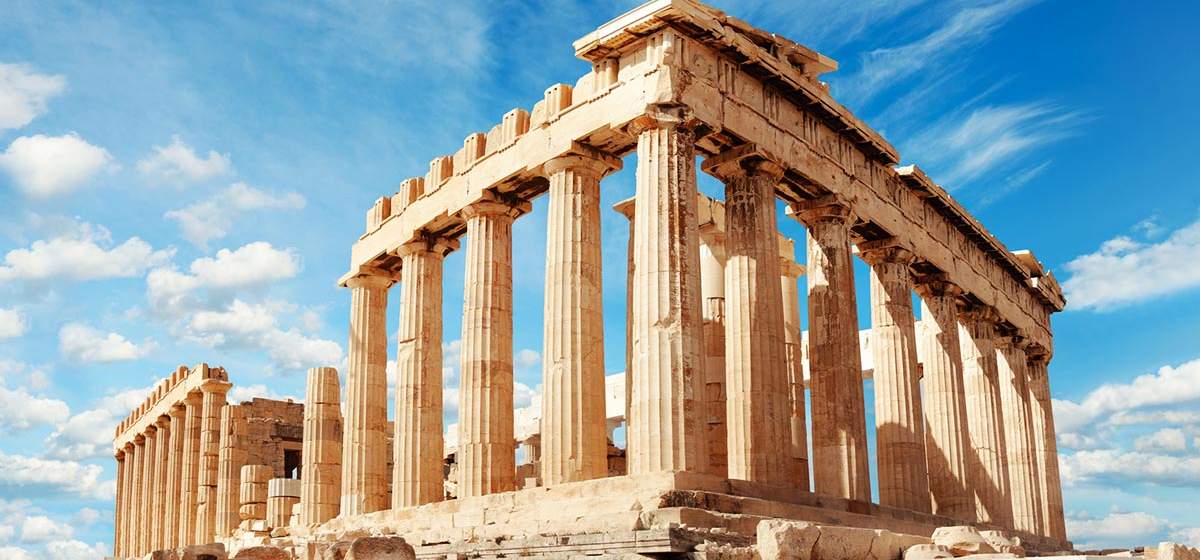
Photo: tilialucida - fotolia.com



Listen to more than 1,700 professional voices or let us put together a casting for you.
Comments (0)